What is armature reaction? Explain briefly the cross magnetizing and de-magnetizing effect of a loaded generator
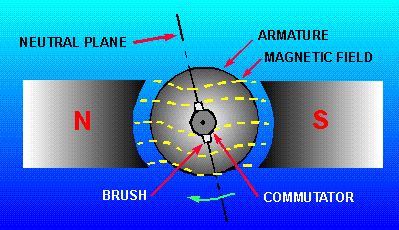
Armature reaction: The
current flow in the armature conductors of a dynamo has an important and
undesirable effect upon the dynamo’s operation. The current in the armature
produces a flux and it is the interaction between this flux and the field flux
that is called armature reaction.
Cross magnetizing and demagnetizing effect: The effects of the armature flux my be analyzed by considering the flux to
consists of two components that are at right angle to each other as shown in
fig.
One component is at right angle to the field, and because this component
crosses the main –field flux, it is
known as the cross –magnetizing component of the armature flux. The second
component is in the same plane as the main field flux . The direction of this
component is opposite to the direction of the main field flux, with the result
the it tends to reduce the effect of the main field flux. This component of the
armature flux , is known as demagnetizing component of the armature flux.
Elimination: A
method to reduce the armature flux on large machines is by the use of
compensating windings .These windings are placed in the pole faces of the field
pole can run parallel to the armature conductors. A connection is made from one of the brushes to one end of this
winding, so that current from the armature must first pass through this winding
before going to the load. The direction of current through the winding is
opposite to that of the current in the armature conductors under the pole. The
location of the compensating winding and of the connection of the winding is
shown in fig. indicates that the current in the armature conductors located
under the north pole carry current away from the observer , therefore the
direction of current following in the part of the compensating windings
situated in the north pole is toward the observer. The direction of flux due to
the current in the armature conductor shown in fig. will be from the brush to
the bottom brush. Since the current in the compensating winding is opposite in
direction to the current in the armature conductors, the flux product by the
current in the compensating winding will be opposite in direction to the
armature flux. The compensating flux , being opposite in direction to the
armature flux, tends to cancel the armature flux. If the armature current
increases, the compensating current increases, so that the armature flux is
cancel for all load conditions.
Comments
Post a Comment