Torque versus armature
current characteristics of DC motor :
The
torque developed by the motor would
therefore be directly dependent upon the armature current as indicated by the
torque equation ,T=K ΦIa. Increasing the armature current would increase the
torque and vice versa.
Shunt motor: For the shunt motor shunt
field is connected accross the line, the flux in the machine will remain
essentially constant .
So,
for shunt motor, T=KΦfIa
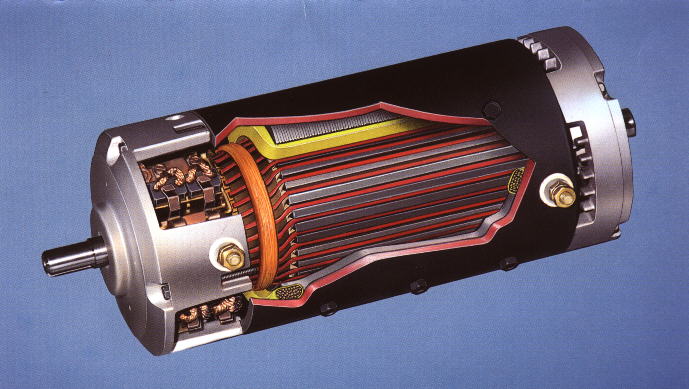
Compound Motor:The
current in the armature must also pass through the series field winding. The
series winding may be connected comulatively were the flux due the series field
will aid the shunt field flux. In cumulative compound motor the series field
flux is additive with the field flux. But in the differentially compound motor
the series field flux is substractive with main field flux. Total flux does not
remain constant in compound motor as it does in the shunt motor.
Cumulative
compound motor T=k(Φf+Φs)Ia
Differentially
compound motor T=k(Φf - Φs)Ia
Series motor: In
a series motor the flux depend upon the current
in the series field, which is the same current that flows through the
armature. We
know ,T=kIaΦ Since
the current in the series field is the
armature current, the equation may be rewritten Ia & Φ
T=k’a
Overall
curve will be
Speed versus armature
current characteristics of Dc motor:
If E is the counter emf, then the
speed equation is E=kΦS
So, shunt motor, S=E/kΦf
=(Vt)/(kΦf)
Cumulative compound, S=E/{k(ΦfΦs)}
=(Vt)/{k(ΦfΦs)}
Differential compound, S=E/{k(ΦfΦs)}=(Vt)/{k(ΦfΦs)}
It
is clear form the equation, if flux is less then the speed is mutch. Also,
increasing armature current decrease speed & vice versa.
For the series motor we know,
S=(Vt)/(k)
If may be rewritten substituting Ia for
S=(Vt)/(kIa)
Comments
Post a Comment